
Why Cell Phones Fail Front-Line Teams: The Radio Advantage
By Nielson Communications
In the modern workplace, the smartphone is often seen as the ultimate tool. It serves as our camera, email client, and GPS. Consequently, many organizations, from local schools and hospitals to public safety agencies and construction firms, have considered replacing traditional two-way radios with the devices employees already carry.
For teams operating on the front lines, a “cell phone only” approach is quickly becoming a major productivity killer and a serious safety liability. Below, we explore why cell phones are failing your team and why successful Wisconsin organizations are switching back to professional communication solutions.
1. The “One-to-One” Communication Bottleneck
First and foremost, cell phones are designed for private, one-to-one conversations. In a professional environment, however, coordination is almost always a “one-to-many” requirement.
-
- In Education, if a school administrator needs to initiate a lockdown, they cannot waste time scrolling through a contact list.
- In Healthcare, when a “code” is called, every second matters. Staff must reach the entire team instantly, rather than playing phone tag.
- In Construction, a foreman needing to halt a crane operation cannot wait for a cellular “ring” cycle to complete.
Ultimately, real-time coordination requires instantaneous group communication. Professional two-way radios allow you to reach your entire workforce with a single touch.
2. The Durability and Reliability Gap
Additionally, while a standard smartphone is a miracle of engineering, it is simply not built for the rigors of professional use.
- Touchscreens vs. Reality: Have you ever tried to answer a critical call while wearing heavy work gloves or medical PPE? Touchscreens are notoriously unreliable in high-pressure or outdoor environments.
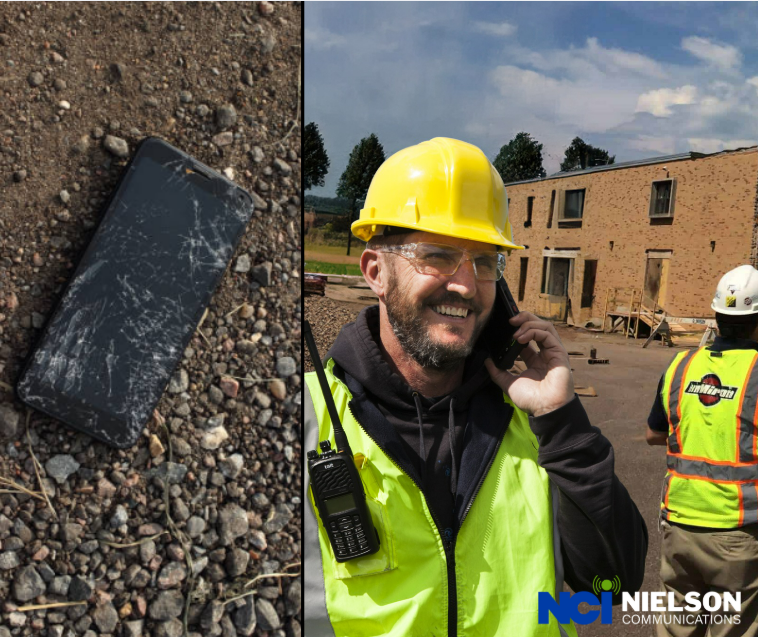
- The “Drop Test” Failure: One drop onto a hospital floor, a warehouse slab, or a dusty job site usually results in an expensive replacement.
- Sanitization Needs: In healthcare settings, professional radios are built with antimicrobial materials and can withstand medical-grade cleaning and maintenance that would destroy a consumer smartphone.
3. Latency, Distraction, and Focus
When a team member pulls out a phone to check a message, they are immediately met with an abundance of distractions, such as personal texts and news alerts. This “context switching” kills operational focus.
Cellular latency, the time it takes for a call to actually connect, can be 5–10 seconds. In public safety or emergency response, those seconds are an eternity. In contrast, dedicated two-way radios provide sub-second connection times, ensuring your message is heard the moment you speak.
The Modern Solution: Professional Digital Networks
Modern Digital Two-Way Radio Solutions bridge this gap perfectly. These devices offer:
- Nationwide Range: Talk from Green Bay to Madison with crystal-clear audio.
- Instant Group Calls: Reach the entire team instantly, every time.
- Rugged Hardware: Survives 5-foot drops and extreme Wisconsin temperatures.
- Zero Distractions: Purpose-built tools that keep your team focused on the mission.
The NCI Advantage: Expertise You Can Trust
Transitioning your communication system is about more than just buying hardware. The effectiveness of your network depends on proper configuration, frequency coordination, and hardware selection.
Whether you are protecting a school, managing a hospital wing, or running a large-scale logistics operation, Nielson Communications has the local expertise to ensure your team stays connected when it matters most.
Ready to upgrade your team’s coordination and ROI?
Reach out to the team at Nielsen Communications today for a System Assessment to identify the specific radio solutions designed for your unique environment.